
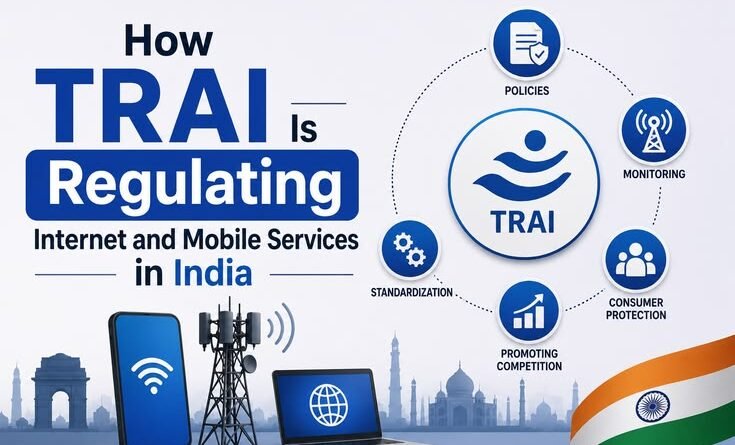
How TRAI Is Regulating Internet and Mobile Services in India
TRAI and Me: How India’s Telecom Watchdog Actually Affects Your Phone Bill, Internet Speed, and Daily Life
I still remember the day I switched from Airtel to Jio back in 2017. Not because I researched data plans obsessively — honestly, I just got tired of paying ₹999 a month for 1GB of daily data that would die by 4 PM. A friend told me Jio was offering free calls and dirt-cheap data. I made the switch in about 20 minutes at a local store.
What I didn’t realize at the time was that none of that would have happened without a regulatory body called TRAI quietly working in the background.
Most people have never heard of TRAI until their phone company does something shady. That’s kind of how it works — good regulation is often invisible until you need it.
So What Even Is TRAI?
The Telecom Regulatory Authority of India was set up in 1997, back when mobile phones were still a luxury that came with ₹16-per-minute call rates. The government realized pretty quickly that letting telecom companies run completely unchecked was a recipe for disaster — price gouging, poor service, no accountability.
TRAI’s job, in plain English, is this: make sure telecom and internet companies don’t take you for a ride.
They don’t run phone networks. They don’t build towers. But they set the rules that everyone — Airtel, Jio, Vi, BSNL, your local broadband ISP — has to follow. Think of them like a referee in a cricket match. You don’t notice them when the game is fair. You’re very glad they exist when someone starts cheating.
The Jio Revolution Wasn’t an Accident
Here’s something most people don’t connect: the reason Jio was able to disrupt the entire Indian telecom market wasn’t just Mukesh Ambani’s money. TRAI’s regulations played a massive role.
Before 2016, data was expensive because there was no strong push for competition on pricing. TRAI had been battling incumbent players for years about spectrum allocation, interconnect charges (the fees networks pay each other when you call someone on a different network), and minimum service quality.
When Jio launched and offered free calls, older networks like Airtel started crying foul. There was a massive fight over call drops between networks — Jio claimed its calls weren’t connecting because Airtel and Vodafone weren’t providing enough interconnect ports. TRAI stepped in, investigated, and ultimately sided with the consumer position: networks have to support adequate interconnection.
The result? Data prices in India fell by over 90% in just a few years. We went from paying ₹250 for 1GB to paying ₹250 for 2GB per day. That’s genuinely one of the most dramatic telecom price drops anywhere in the world.
The Net Neutrality Battle — And Why You Should Care
This is probably TRAI’s most important recent decision, and it happened because ordinary Indians spoke up.
In 2015, Facebook launched something called Free Basics — a program that would give free internet access in India, but only to a limited set of websites. Facebook, obviously, was one of them. The idea was marketed as bringing “the internet” to rural India.
TRAI put out a consultation paper asking the public what they thought. What followed was unprecedented: over a million Indians wrote to TRAI opposing the idea. The argument was simple — if Facebook gets to decide which websites are free, they’re not giving you the internet. They’re giving you their version of the internet.
In February 2016, TRAI banned discriminatory pricing of data services. This was a net neutrality win. It meant no telecom or internet company could charge you differently based on which website or app you were using. Your 1GB of data works equally on Google, YouTube, a small news blog, or a startup’s new app.
I remember the debate vividly because a relative of mine who works in digital marketing was completely panicking — his startup’s website would have essentially been invisible if differential pricing had been allowed. TRAI’s ruling was a genuine relief.
Then in 2018, TRAI went even further and formalized net neutrality rules — ISPs cannot block, throttle, or give preferential treatment to specific internet traffic. It’s one of the stronger net neutrality frameworks in the world, honestly.
Call Drops, Slow Internet, and How to Actually Complain
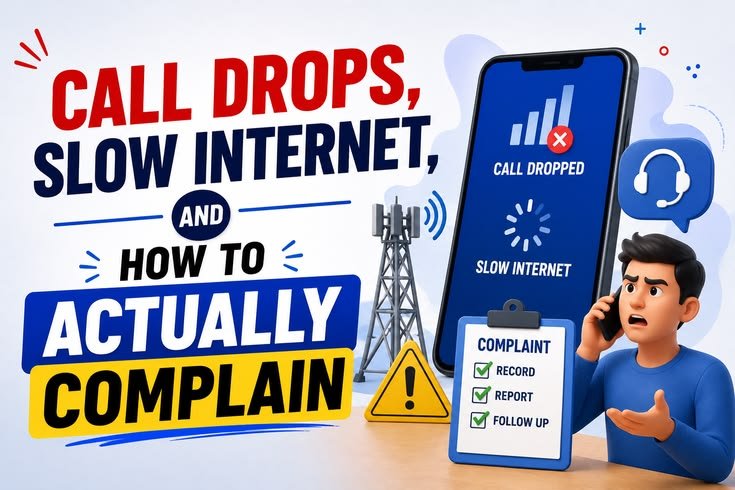
One thing I learned the hard way: you don’t have to just accept bad service.
A few years ago I was getting terrible 4G speeds in my area — we’re talking 0.5 Mbps on a network that was supposed to deliver 15-20 Mbps. I called customer care about seven times over three weeks and got nowhere. Then someone mentioned filing a complaint with TRAI directly.
Here’s how to actually do it:
Step 1: Use the TRAI MyCall app first. This is a real app (available on Android and iOS) that TRAI built specifically to track call drops and voice quality. Every time your call drops, you log it. TRAI uses this crowd-sourced data to hold telecom companies accountable. I didn’t know this existed for years — started using it and it actually feels like your feedback goes somewhere.
Step 2: Try the Sanchar Saathi portal. This is more for issues like SIM fraud, unauthorized connections in your name, or mobile number portability problems. If someone’s taken out a SIM in your name (which unfortunately does happen), Sanchar Saathi at sancharsaathi.gov.in is your first stop.
Step 3: Escalate to the Telecom Ombudsman (CGPDTM). If your complaint with the service provider isn’t resolved in 30 days, you can approach the Centralized Grievance Redress and Monitoring System. It sounds complicated but it’s basically a formal escalation mechanism that telecom companies have to respond to.
Step 4: For internet speed specifically, TRAI has a broadband speed testing app called TRAI Speed Test. If your ISP is consistently delivering way below the promised speed, documented tests from this app can support a complaint.
I’m not going to pretend this process always ends perfectly. It doesn’t. But I’ve seen it work — a neighbor of mine got compensation from her ISP after persistent complaints backed by documented speed tests.
The OTT Question — Streaming, WhatsApp, and the Ongoing Debate
Here’s where things get interesting and a bit unresolved.
Telecom companies have been lobbying TRAI for years to regulate OTT (over-the-top) services like WhatsApp, Netflix, Zoom, and similar platforms. Their argument: “These companies use our network infrastructure but don’t pay for it or follow the same rules we do.”
TRAI has been going back and forth on this. As of now, OTT services in India are not regulated under the same framework as telecom operators. You don’t need a license to run a VoIP service or a streaming platform.
But the debate isn’t settled. TRAI issued a consultation paper on OTT regulation, and it’s been a point of contention. Consumer groups worry that heavy regulation of OTT services could mean higher prices or restricted access to apps you use daily. Telecom companies want a level playing field.
Watch this space — it’s genuinely going to affect what you pay for apps and calls over the next few years.
Mistakes People Make (Including Me)
Assuming your telecom company is your only option. TRAI has made number portability pretty painless. If your network is consistently bad, switching is genuinely easy now. I’ve ported numbers twice without losing my number.
Not knowing about the DND Registry. If you’re drowning in spam calls (and who isn’t), TRAI’s Do Not Disturb registry at trai.gov.in is real and does work — at least for regulated telemarketers. You can register and also report violators. I did this and spam calls dropped noticeably within a few weeks.
Ignoring data speed guarantees. Most people don’t know that TRAI has set minimum broadband speed definitions. If a company advertises “broadband,” it legally must mean a certain minimum speed. If you’re getting 512 Kbps called “broadband,” that’s worth questioning.
Thinking TRAI handles cybercrime. Common confusion — TRAI regulates telecom and internet services, not online fraud or cybercrime. For that, you want the Cyber Crime Portal at cybercrime.gov.in. Different agency, different purpose.
What TRAI Is Still Getting Wrong
I’d be giving you an incomplete picture if I didn’t mention where TRAI falls short.
Enforcement is uneven. Telecom companies still consistently violate speed and quality norms without significant penalties. The fine structures are outdated relative to how much these companies earn.
Rural connectivity remains patchy. TRAI has pushed Universal Service Obligation funds to improve rural internet, but implementation has been slow. People in semi-urban areas frequently deal with coverage claims that don’t match reality.
The grievance redressal process is still too slow and too opaque for most average users. Most people give up before they see resolution.
Why This Actually Matters to You
Here’s my honest take: TRAI isn’t perfect, and Indian telecom regulation isn’t the gold standard globally. But compared to where we were in the early 2000s — expensive calls, monopolistic behavior, zero consumer recourse — the progress is real.
The net neutrality rules alone put India ahead of several developed nations on paper. The aggressive intervention during the Jio-Airtel standoff genuinely benefited consumers. The DND registry, the speed testing tools, the complaint mechanisms — these are all imperfect but functional tools that most people never use simply because they don’t know they exist.
If you’re paying for a service and not getting it, you have more recourse than you probably think. That’s worth knowing.
The referee might not catch every foul. But they’re on the field — and that matters.