Best Free Coding Courses That Give Job in India 2026
Best Free Coding Courses That Actually Get You a Job in India (2026)
A cousin of mine from Jaipur spent almost two years uploading selfies with laptop stickers on Instagram calling himself a “developer” — while never finishing a single project. He had certificates from five platforms. He had no job.
That story isn’t unique. Half the people I’ve spoken to who are learning to code in India are drowning in certificates from courses they can’t apply. The other half are grinding the right stuff and getting placed. The difference isn’t talent. It’s which courses they picked and how they used them.
So let me tell you what actually works in 2026 — based on what I’ve seen, what job postings demand, and what hiring managers at Indian product companies and service firms are genuinely looking for.
First, why “free” doesn’t mean “useless” anymore
A few years ago, free courses were mostly YouTube lectures with no structure. Now, platforms like The Odin Project, CS50, and NPTEL are genuinely rigorous. Some are better than paid bootcamps that charge ₹1–2 lakh. The catch is that free courses demand more self-discipline — nobody is chasing you for assignments.
Also, Indian recruiters don’t care where you learned. They care what you built and whether you can code in front of them. That shifts the whole equation.
1. CS50x by Harvard (edX) — for absolute beginners who are serious
This is the one I recommend to anyone who has never written a single line of code. Not because it’s Harvard — that name doesn’t impress Indian HRs — but because CS50 actually teaches you how computers think, not just syntax.
It covers C, Python, SQL, JavaScript, and basic web development. The problem sets are genuinely hard. You’ll build a finance tracker, a spell-checker, a web app. These become your first portfolio pieces.
The certificate is free if you audit. If you want the official Harvard certificate, there’s a small fee — but honestly, the portfolio matters more than the cert.
Time needed: 3–6 months if you’re doing it alongside college or a job.
Best for: People who want a solid foundation before jumping into React or Django.
One mistake I see: People rush CS50’s Week 0–3 and quit at Week 5 when C memory gets hard. Don’t. Push through. That’s where you actually grow.
2. The Odin Project — for full-stack web development
This is an open-source curriculum that takes you from zero to a deployable full-stack app using HTML, CSS, JavaScript, Node.js, and either Ruby on Rails or React. It’s completely free, no sign-up wall, no upsells.
The key difference here is that The Odin Project makes you build actual projects from scratch — not fill-in-the-blank exercises. By the end, you’ll have a personal portfolio, a todo app, a weather app using real APIs, and a full CRUD application on GitHub.
Recruiters at Indian startups — especially in Bengaluru, Pune, and Hyderabad — are comfortable seeing Odin Project work on GitHub if the code is clean and well-commented.
Time needed: 6–12 months for the full-stack path.
Common mistake: Skipping the “foundations” section because it feels too slow. Don’t. Those fundamentals are what interviewers quiz you on.
3. NPTEL Courses (IIT & IISc) — underrated in India
If you’re a college student or recent graduate in India, NPTEL is genuinely undervalued. The courses are taught by IIT and IISc professors — people like Prof. Naveen Garg on Data Structures, or the famous “Programming in Python” series.
What makes NPTEL stand out is the proctored exam system. If you pay a small fee (₹1000–1500) and take the proctored exam, you get a certificate from IIT/IISc. Some Indian companies — especially PSUs, IT giants like TCS, Infosys, and even mid-level product companies — give these certificates real weight.
The courses are on swayam.gov.in and youtube.com/nptel.
Best courses to check: Data Structures and Algorithms, Database Management Systems, Operating System Concepts, Programming in Java.
Pro tip: Do the NPTEL DBMS course before any SQL interview. It’s thorough in ways that paid Udemy courses aren’t.
4. freeCodeCamp — structured, project-heavy, and genuinely free
freeCodeCamp gives you certifications in Responsive Web Design, JavaScript Algorithms, Front End Libraries (React), Back End Development (Node + Express + MongoDB), Data Visualization, and more.
Each certification requires you to build 5 projects that meet specific user stories. These aren’t trivial. The JavaScript Algorithms and Data Structures certification will make your brain hurt in the best way.
The freeCodeCamp forum is also one of the most helpful communities online, which matters a lot when you’re stuck at midnight debugging a CSS flex issue.
Time per certification: 100–300 hours, depending on your pace.
Where it helps in India: MERN stack developers (MongoDB, Express, React, Node) are in high demand. freeCodeCamp covers exactly this stack.
5. Google’s Data Analytics / IT Support Certificate (via Coursera) — free for some, subsidized for others
Google offers these via Coursera and they’re genuinely good for non-programmers who want to break into tech without becoming a developer. The IT Support Certificate covers networking, OS, security, and troubleshooting. The Data Analytics Certificate covers spreadsheets, SQL, R, and Tableau.
Coursera sometimes offers financial aid — you can apply and get these for free if approved. Don’t pay full price.
Where these land jobs in India: IT Support roles at MNCs, L1/L2 support, data analyst roles at mid-size companies, BPO-to-tech transitions.
Honest caveat: For pure software engineering roles, these alone won’t get you there. Pair them with Python or SQL practice on platforms like LeetCode or HackerRank.
6. Kaggle Learn (for Data Science and ML)
If you want to go into data science, machine learning, or AI — which are genuinely hot in India right now — Kaggle Learn is the most practical free resource I’ve come across.
Each course is short (4–8 hours), intensely practical, runs in your browser, and you work with real datasets. Topics include Python, Pandas, SQL, Machine Learning, Deep Learning, Computer Vision, and NLP.
Finishing Kaggle Learn and then competing in a few beginner Kaggle competitions gives you a portfolio that data roles notice.
Time needed: 2–3 months to finish all tracks.
Bonus: Kaggle notebooks on your profile serve as a public portfolio, similar to GitHub for developers.
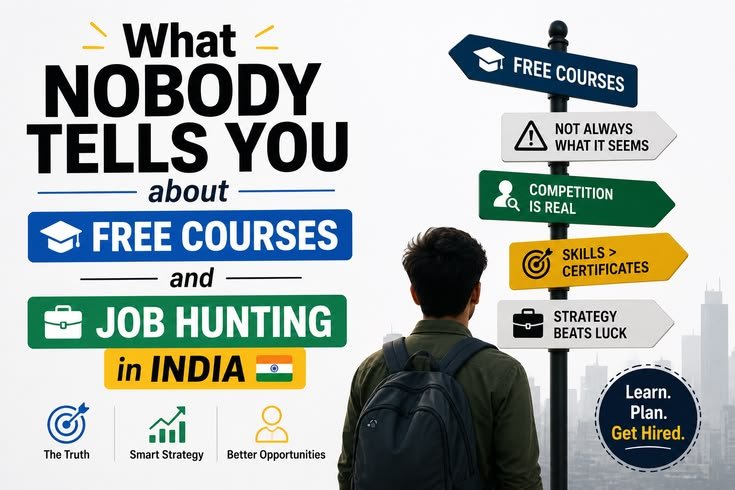
What nobody tells you about free courses and job hunting in India
Here’s something I wish someone had said to me earlier:
Certificates don’t get you interviews. GitHub does. A well-maintained GitHub profile with 3–5 real projects beats 20 certificates every single time. When I say “real projects,” I mean things with a README, actual functionality, and ideally, something deployed on Render, Vercel, or Railway.
Second thing: placement in Indian companies often comes through referrals. LinkedIn connections matter. Join communities — Hasgeek, communities on Discord for Indian developers, local meetups. The person who gives you a referral may have no idea you exist if you’re just quietly finishing courses alone.
Third: practice DSA (Data Structures and Algorithms) separately, regardless of which course you pick. LeetCode easy and medium problems are the language of Indian tech interviews, especially for service companies and product startups. None of the courses above will prepare you for this alone. Use LeetCode, GeeksforGeeks, or Striver’s A2Z DSA Sheet on YouTube — it’s free and excellent.
A realistic timeline if you’re starting from scratch today
Month 1–2: CS50 Weeks 0–4 (fundamentals, C, Python basics) Month 3–4: freeCodeCamp JavaScript Algorithms OR The Odin Project Foundations Month 5–7: The Odin Project Full-Stack OR Kaggle Learn (depending on your track) Month 8–9: Build 3 portfolio projects, push to GitHub Month 10–12: Daily DSA practice + LinkedIn networking + apply aggressively
This is roughly 10–12 months of disciplined effort. Anyone selling you a “6-week bootcamp guarantee” is selling something else.
Courses to avoid (or at least not rely on alone)
Udemy courses with 28-hour videos where you watch someone type and feel productive — but never actually code yourself. They’re fine as supplements. They shouldn’t be your main strategy.
Random YouTube playlists with no structure. Again, fine for learning specific concepts. Bad as a primary learning path.
Any “certification course” that doesn’t make you build something.
Last thought
The cousin I mentioned at the start eventually figured it out — six months ago he got his first job as a junior developer at a SaaS startup in Jaipur. What changed? He stopped collecting certificates and started finishing projects. He built a simple expense tracker, a basic clone of a UI he liked, and a REST API with Node and MongoDB. That GitHub profile, three projects, is what landed him the interview.
Free courses gave him the knowledge. What gave him the job was actually using it.
That’s the whole game.