
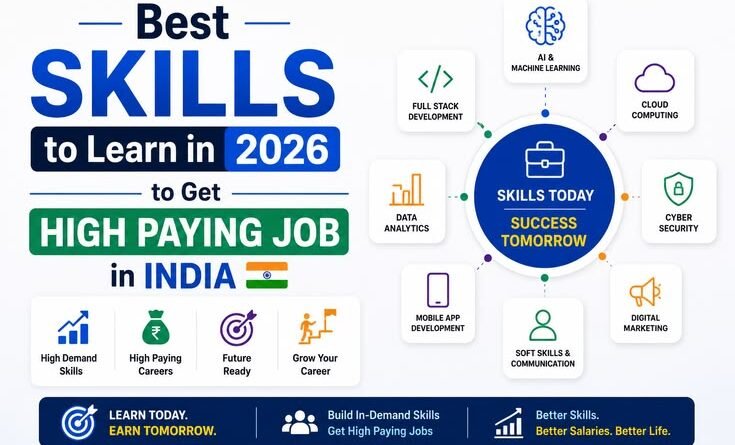
Best Skills to Learn in 2026 to Get High Paying Job in India
My cousin Rahul spent three years doing a BCA degree, passed with decent marks, and then sat at home for eight months unable to get a job. Not because he was lazy — he applied everywhere. The problem? His skills were stuck in 2019 while the job market had completely moved on.
I’ve seen this story play out too many times. Freshers and even mid-level professionals grinding through outdated courses, spending money on certifications nobody cares about, and wondering why the interview calls don’t come. So I figured I’d write down what’s actually working in 2026 — based on what I’ve personally observed, what hiring managers I’ve spoken to actually want, and what the job boards are screaming for right now.
This isn’t a generic “learn Python or AI” article. Let’s go deeper than that.
Why 2026 Is Actually a Different Ballgame
Something shifted hard in the last couple of years. Companies in India — especially in Bengaluru, Hyderabad, Pune, and even tier-2 cities — started cutting down on “generalist” roles and doubling down on people who can do specific, measurable things.
The IT sector that once hired thousands of freshers just to train them? That model is cracking. Infosys, TCS, Wipro — they’ve all talked about “right-skilling” rather than bulk hiring. What that means for you is simple: if you walk in without a concrete, demonstrable skill, you’re invisible.
The good news? The window to build those skills has never been more open. Courses are cheaper, resources are everywhere, and employers are genuinely hungry for people who know what they’re doing.
Here’s what those skills actually are.
1. Generative AI and Prompt Engineering (But Properly)
Everyone’s saying “learn AI.” But here’s what most people miss — companies aren’t just looking for people who know AI exists. They want people who can use it to solve real business problems.
Prompt engineering sounds like a buzzword, but I’ve personally used it to cut content research time by 60% and help a friend’s startup automate their customer onboarding emails. It’s a real, practical skill.
What to focus on:
- Learn how to use tools like Claude, ChatGPT, Gemini for actual workflows — not just asking it to write poems
- Understand how to build GPT-based assistants using OpenAI API or Anthropic API
- Get into LangChain or n8n if you want to go deeper into automation
Where to learn: DeepLearning.AI has solid short courses. Coursera’s GenAI for everyone is a good starting point. Most of it is free or under ₹2,000.
The salary upside? Roles like “AI Automation Specialist” or “Prompt Engineer” in Indian startups are offering ₹8–18 LPA even at entry level in 2026.
2. Data Analytics — Not Data Science (There’s a Difference)
I made this mistake myself. I assumed “data science” was the golden ticket and spent months trying to learn machine learning from scratch. It nearly broke me.
Here’s the thing — most Indian companies don’t need a machine learning researcher. They need someone who can look at messy sales data, make sense of it in Excel or SQL, build a clean dashboard in Power BI or Tableau, and tell the management what’s actually going on.
That’s data analytics. And demand for it is absolutely wild right now.
Start here:
- Excel + Advanced Excel — Sounds basic, but 90% of analysts still live here
- SQL — Learn it on Mode Analytics or SQLZoo, takes about 3–4 weeks seriously
- Power BI — Microsoft’s free version is powerful enough for most jobs
- Python basics — Just enough for pandas and matplotlib
A friend of mine in Jaipur landed a ₹9 LPA job at a logistics company with exactly these four skills. No fancy degree. Just a solid portfolio of 3–4 real-looking dashboards he built on public datasets from Kaggle.
3. Cloud Computing — AWS or Azure, Pick One
Cloud isn’t the future anymore — it’s the present. Every company that’s scaled past a certain size in India runs on cloud infrastructure. And there’s a massive talent gap in people who can actually manage it.
You don’t need to become a cloud architect overnight. Start with:
- AWS Cloud Practitioner certification (roughly ₹8,000 to take the exam, prep is free on YouTube via FreeCodeCamp or TechWithLucy)
- Then move to AWS Solutions Architect – Associate if you want the big jump
Azure is equally valid, especially if you’re targeting MNCs or companies using Microsoft ecosystems.
A mid-level AWS Solutions Architect in India earns ₹15–35 LPA in 2026. Even entry-level cloud support roles are touching ₹6–8 LPA in cities like Pune and Chennai.
4. Full-Stack Web Development (With a Modern Stack)
This one’s been on every list for years, but the specific skills within it have shifted.
If you’re learning web dev in 2026, here’s what actually gets you hired:
- React.js on the frontend (still dominant)
- Node.js + Express or Next.js for backend
- MongoDB or PostgreSQL for databases
- Basic DevOps — knowing how to deploy to Vercel, Railway, or AWS EC2
The mistake I see freshers make is learning outdated stacks from YouTube tutorials made in 2018. Please check the upload date before binge-watching 10 hours of anything.
The Odin Project and Full Stack Open (from University of Helsinki, completely free) are genuinely excellent and up-to-date.
One thing that sets candidates apart in 2026: building something real. Not another to-do app. Pick a problem — maybe a local kirana store needs an inventory tracker — and actually build it. That one real project does more for your resume than five certificates.
5. Cybersecurity — The Skill India Is Quietly Desperate For
India has been hit by a wave of data breaches, ransomware attacks, and phishing scams. As more companies go digital (thanks partly to government pushes like Digital India), the need for people who understand security is exploding.
Entry points:
- CompTIA Security+ certification — globally recognized, takes 2–3 months of prep
- CEH (Certified Ethical Hacker) — more expensive but valued highly in India
- Practice on TryHackMe or Hack The Box — these are gamified platforms that make learning security actually fun
Cybersecurity roles are starting at ₹6–10 LPA for freshers with the right certification in 2026, and senior roles easily cross ₹30 LPA.
6. Digital Marketing + SEO (For Everyone Who Isn’t Into Coding)
Not everyone loves staring at code. That’s completely fine — the demand for skilled digital marketers in India is massive and growing.
But here’s where I’d push back on the obvious advice: don’t just learn “social media marketing.” That’s saturated and underpaid.
Go specific:
- SEO (Search Engine Optimization) — especially technical SEO, which barely anyone knows well
- Performance Marketing — running paid ads on Google and Meta with actual ROI tracking
- Email Marketing with automation tools like Mailchimp or Klaviyo
Tools to master: Google Analytics 4, SEMrush (free trial is enough to learn on), Google Search Console, Meta Ads Manager.
A performance marketer who can show real ROAS (Return on Ad Spend) numbers from actual campaigns is worth their weight in gold to any D2C startup. Salaries range from ₹5–20 LPA depending on experience and results.
7. Communication and Personal Branding — The Skill Nobody Talks About
This one isn’t on any curriculum but it’s the difference-maker I’ve seen in real life.
I know a guy — barely average coder, honestly — who gets constant inbound job offers because he writes regularly on LinkedIn and shares what he’s learning. Companies find him. He doesn’t job hunt.
In 2026, being findable online is a skill. Building a personal brand on LinkedIn, writing case studies about projects you’ve worked on, documenting your learning journey — it signals credibility in a way that a resume simply cannot.
Also, communication in English (and especially business communication) continues to matter enormously in Indian corporate settings. Platforms like Toastmasters, Coursera’s English communication courses, or even just practicing by recording yourself on your phone — these things compound over time.
Common Mistakes to Avoid
- Certificate hoarding: Collecting 12 Udemy certificates without building anything real looks terrible to recruiters.
- Learning in isolation: Join communities — Discord servers, Reddit’s r/india tech threads, local meetups on Meetup.com. Real humans give you real feedback.
- Ignoring the basics: I’ve seen people skip learning Git/GitHub and it’s biting them. Every technical role expects this. Learn it in a weekend.
- Chasing hype blindly: Blockchain and NFTs were “must-learn” in 2021. You know how that went. Research actual job postings on Naukri, LinkedIn, and Internshala before investing months into anything.
Where to Actually Start Tomorrow
Here’s a simple 3-step action plan:
- Pick ONE skill from this list — not three, one. Base it on what genuinely interests you, not just salary.
- Give it 90 days of serious effort — 1.5 to 2 hours daily minimum. Use free resources first (YouTube, freeCodeCamp, The Odin Project).
- Build something and put it online — GitHub, a portfolio site, or even a LinkedIn post breaking down what you made. This is non-negotiable.
The Indian job market in 2026 isn’t impossible — it’s just more specific about what it wants. The people landing great jobs aren’t necessarily the smartest in the room. They’re the ones who picked a real skill, went deep on it, and showed their work.
Rahul, my cousin from the beginning of this story? He spent four months learning Power BI and SQL on YouTube and Kaggle after I pushed him to stop collecting random certificates. He’s now at a fintech company in Pune earning ₹8.5 LPA. He still messages me about new dashboards he’s building.
Pick your skill. Start today. The market will notice.