
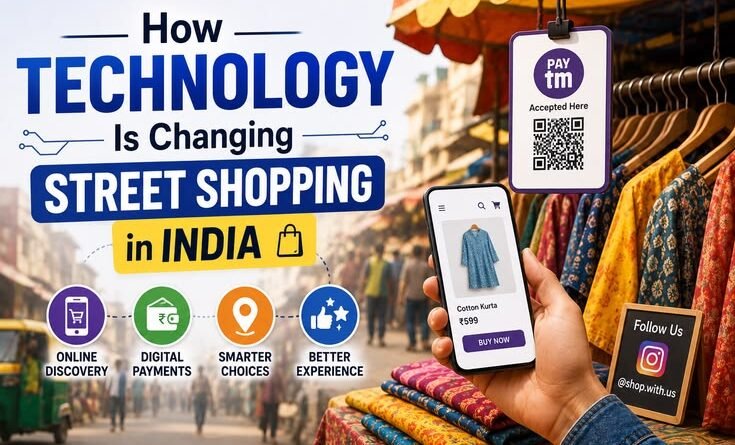
How Technology Is Changing Street Shopping in India
Last winter, I was bargaining for a pair of juttis at a small stall near Sardar Market in Jodhpur. The vendor — a man in his 50s with a weathered face and a calculator in hand — suddenly pulled out his phone and said, “Bhai, Google Pay kar do.” No change needed. No drama. Just a QR code, a beep, and done.
That moment stuck with me. Here was a guy who had been selling handmade shoes the same way for probably 25 years. And in two seconds, technology had quietly slipped into his world — and mine.
Street shopping in India is unlike anything else. It’s chaotic, loud, sensory overload in the best possible way. You don’t just buy things — you negotiate, taste, touch, argue, and sometimes walk away only to come back five minutes later. It has a rhythm. And now? Technology is syncing to that rhythm in ways nobody really planned.
The UPI Revolution Nobody Talks About Enough
Let me be honest — I used to hate carrying exact change at street markets. You’d want to buy a ₹180 item and hand over ₹200, and suddenly the vendor would disappear into the crowd looking for ₹20 that doesn’t exist. That small frustration added up.
Then UPI happened.
PhonePe, Google Pay, Paytm — these apps didn’t just go mainstream in malls and restaurants. They quietly swept through pheriwalas, thela vendors, and small stall owners in every gali of every Indian city. I’ve paid for chai, earrings, fresh mosambi juice, and second-hand books all via QR code in the past year alone.
What’s wild is how fast it happened. A 2022 push by the government for cashless transactions post-COVID essentially forced adoption. Vendors who resisted found customers increasingly impatient about change. So they adapted.
The real impact? It’s reduced the friction of small purchases massively. Vendors are selling more because impulse buys are now instant. Earlier, if you didn’t have ₹50 in your wallet, you’d pass. Now? Three taps and you own that hand-painted pot.
Street Vendors Are Going Instagram Before Going Anywhere Else
Here’s something I didn’t expect to notice until a vendor in Chandni Chowk showed me his Instagram profile mid-negotiation.
“Yeh dekho, yahan 40K followers hain.” (Look, I have 40K followers here.)
He was a saree seller. His physical stall was modest — maybe 6 feet wide. But online? His reach was enormous. He’d post reels of himself draping sarees, showing fabric textures up close, and tagging his location. People from Bengaluru and Pune were DMing him for custom orders and paying via bank transfer.
This isn’t rare anymore. Vendors selling everything from antique locks to hand-block-printed dupattas have figured out that Instagram and YouTube Shorts are essentially free advertising. No middleman, no rent for a bigger shop, no distribution cost.
What they’re doing right:
- Short videos showing product detail and texture (way better than static images)
- Using local language captions — Hindi, Marathi, Tamil — to build community
- Turning regular buyers into content creators by asking them to post and tag
I made the mistake of buying something from a vendor without checking his Instagram first. Paid ₹350 for a Rajasthani lamp. Saw the same vendor selling it for ₹280 on his profile the next day with a “DM for discount” caption. Lesson learned.
The QR Code Menu Came to the Chaat Stall
This one genuinely surprised me.
A chaat stall near my neighbourhood — the kind with a plastic sheet over a wooden cart — now has a printed QR code menu laminated to the side of it. You scan it, see the full menu with prices, and it even has a “today’s special” section that the owner updates from his phone.
He told me his son set it up using a free tool (he wasn’t sure which one, but it looked like it could have been QR Tiger or a similar service). No app required on the customer’s side. Just a scan.
Is it life-changing? Not dramatically. But it saves him from explaining the same 12 items twenty times a day, and it means prices are visible — which actually reduces negotiation time and awkward moments.
Small tech. Real impact.
How Vendors Are Using WhatsApp As a Full Business Tool
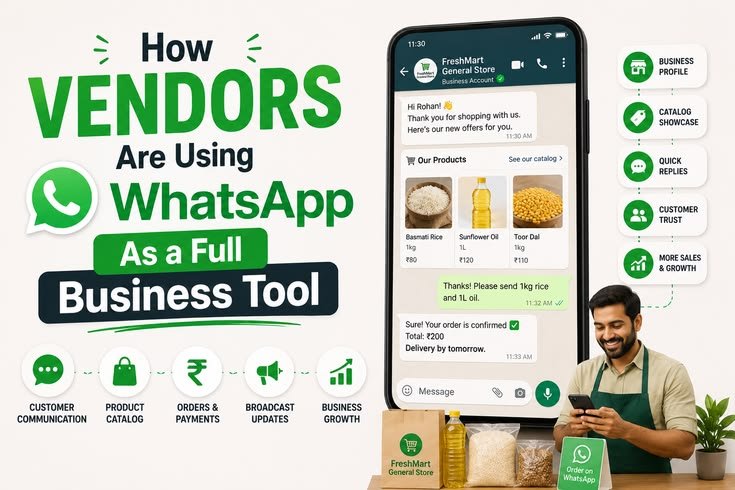
I want to talk about WhatsApp Business for a second because I think it’s massively underrated in this context.
A cloth merchant I know in a small town near Jodhpur now has a WhatsApp Business account with a product catalogue. He photographs his fabrics, uploads them with prices, and shares his catalogue link with regular customers. When new stock arrives, he sends a broadcast message.
His regulars — including buyers in other cities who visited once during a trip — place orders and pay online. He ships via India Post or local courier.
This man does not have a website. He doesn’t need one. WhatsApp is his storefront for remote customers, while his physical stall handles walk-ins.
The WhatsApp Business app is free. The learning curve is low. And for a vendor who can’t afford or manage an e-commerce listing, it works beautifully.
Practical tip if you’re a vendor reading this:
- Download WhatsApp Business (separate from regular WhatsApp)
- Set up your profile with address, hours, and a short description
- Build a product catalogue — even 10-15 photos with prices is enough
- Create a broadcast list of your regular customers
- Send updates when new stock arrives — not too often, or people will mute you
Smart Speakers and Voice Search Are Changing How People Find Street Markets
This one is more subtle but worth paying attention to.
More and more people are searching for street markets using voice — “Ok Google, kapda market near me” or “Alexa, where to buy cheap electronics in Nehru Place.” Local SEO and Google Maps listings have become genuinely important even for street-level vendors.
Markets and individual vendors who have bothered to get listed on Google Maps are seeing walk-in traffic they never had before. I found an incredible leather workshop in a tucked-away lane in Jodhpur purely because someone had uploaded photos and a review on Google Maps. Without that, I’d have walked right past it.
If you run a stall or know a vendor who does — help them get on Google Maps. It takes 15 minutes and costs nothing.
What’s Still Broken (And Why I Think That’s Okay)
All of this is exciting, but let me be real — the digital-physical gap is still massive.
Connectivity drops out in crowded markets. A ₹5 chai vendor isn’t going to manage a WhatsApp catalogue. Many older vendors find UPI confusing and have been scammed through fake screenshot tricks. The enthusiasm for tech adoption is real, but so are the risks.
I’ve seen vendors lose money because a customer showed a fake “payment successful” screen and walked away. It happens more than you’d think. Now many ask to check their own phone before handing over goods — a small but important habit.
Also, there’s a generational thing at play. Younger vendors — often the children of older stall owners — are the ones driving tech adoption. When they’re not around, the digital tools go unused. That’s not necessarily a problem; it’s just the reality of how change actually spreads.
A Few Things Worth Knowing If You Shop at Street Markets
Verify payments on your own device. Don’t rely on the vendor’s screen showing success. Check your bank notification.
Download Google Pay and Paytm both. Sometimes one works where the other doesn’t depending on the vendor’s linked bank.
Follow your favourite vendors on Instagram. Seriously. You’ll find out about sales, new stock, and sometimes get better deals through DMs than in person.
Use Google Maps to discover hidden gems. Filter by “open now” and browse the photos section. Some of the best stalls in India are buried in Maps reviews.
Don’t assume low-tech means low quality. Some of the most skilled artisans I’ve met are barely on the internet. The QR code doesn’t tell you anything about the craft.
Where This Is All Heading
Street shopping in India is not going to become some slick, sanitized e-commerce experience. That’s not the point. The chaos, the smell, the actual human bargaining — that’s irreplaceable and frankly, it’s why people keep coming back.
But technology is adding a layer on top of that. It’s making payments smoother, helping vendors build audiences beyond their physical location, and connecting buyers to sellers in ways a physical stall alone never could.
The most interesting businesses I’ve seen aren’t the ones choosing between “old-school stall” and “going fully online.” They’re doing both — physical presence for the experience, digital tools for reach and convenience.
That jutti vendor in Jodhpur? He took my UPI payment, wrapped my shoes in newspaper the old way, and handed them over with a smile that had nothing to do with technology. The app handled the transaction. The craft was entirely his.
That balance — that’s the real story of how tech is changing street shopping in India. Not replacing it. Just making more room for it to grow.